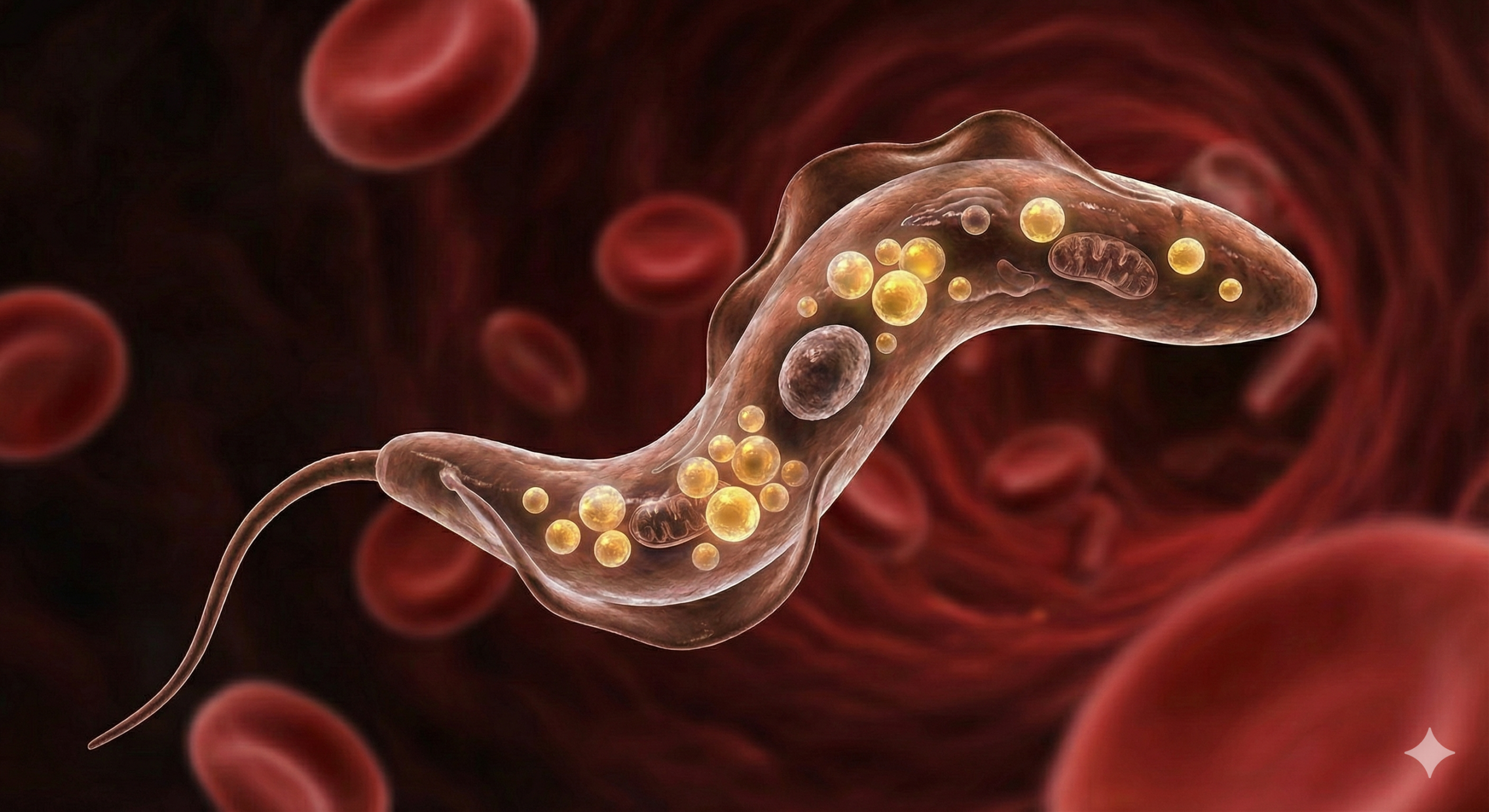
At the heart of trypanosome metabolism, the mystery of the droplets
Background: African Trypanosomes
The organism: African trypanosomes are single-celled parasites. Unlike other intestinal parasites such as Taenia, they are microscopic and invisible to the naked eye.
Life cycle: They are highly adaptable because they move between two very different environments: an insect vector (the tsetse fly) and a mammalian host (humans or animals).
Diseases: In humans, they cause sleeping sickness, a neglected tropical disease that is on the verge of being eliminated. In animals, they cause “nagana” in livestock, resulting in financial losses estimated at billions of euros and hindering Africa’s development.
The Scientific Problem: The Mystery of Lipid Droplets
What is it? Les gouttelettes lipidiques sont des compartiments cellulaires dynamiques issus du réticulum endoplasmique, entourés d’une couche de phospholipides.
Their function: They serve as a metabolic platform and interact with mitochondria and peroxisomes to regulate energy, lipids, and cellular signaling.
The observation: Although their importance has been recognized for the past five years in general biology, their role in trypanosomes remains largely unexplored and underestimated. This is where the project’s originality lies.
The objectives of the ANR OIL project
The goal: OIL is a basic research project aimed at unraveling the biology of these droplets (composition, dynamics, functions) within the parasite.
Methodology: The team uses a wide range of cutting-edge technological approaches:
Challenges and Prospects: Understanding Adaptation: The parasite must adapt its metabolism and morphology to survive environmental change (fly vs. mammal). Understanding lipid droplets means understanding this survival.
Basic Research: Beyond the parasite, these discoveries often shed light on mechanisms in “higher” organisms and help solve broader biological puzzles.
This site is registered on wpml.org as a development site. Switch to a production site key to remove this banner.